
The International Fund for Agricultural Development (IFAD) is studying the Family Dairy Farms project as part of its efforts to develop new support programs for small-scale farming in Ukraine.
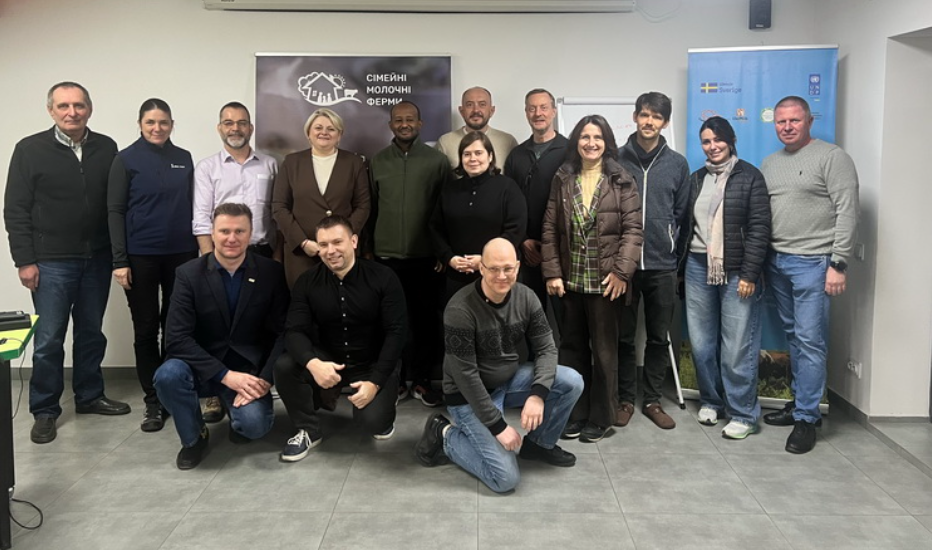
Recently, a delegation from the United Nations specialized financial institution, which invests in rural development, smallholder agriculture, market access, financing, knowledge sharing, and sustainable growth, visited the project to learn from its practical experience.
During the visit, the Family Dairy Farms team outlined the key challenges facing small milk producers. One of the main conclusions was that the most common household farms with one to three cows remain largely subsistence operations and, at current raw milk purchase prices, cannot function as sustainable commercial businesses.
Project experts emphasized that an economically viable dairy farm should operate with at least 30 cows. At this scale, dairy farming becomes a profitable business rather than a means of partial household self-sufficiency. Reaching this level requires long-term planning, with investments in barns and technical infrastructure designed from the outset for a farm of this size. According to the project’s estimates, a 30-cow dairy farm typically reaches payback within three to four years.
The project also stressed that the long-term future of Ukraine’s dairy sector depends on transforming household producers into fully registered businesses, such as sole proprietorships or limited liability companies.
With current farm-gate milk prices averaging UAH 8–9 per liter, creating added value through on-farm milk processing has become essential. By operating a small cheese dairy, farmers can increase their earnings to more than UAH 30 per liter of milk.
Another key recommendation presented during the meeting was the development of regional agricultural clusters, where farmers cooperate in milk processing, bulk feed purchasing, veterinary services, and other shared activities. This cluster-based approach has become one of the central pillars of the Family Dairy Farms development strategy for the coming years.